

Russia


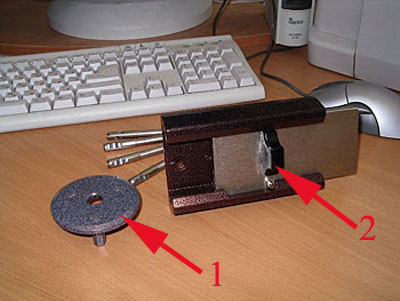
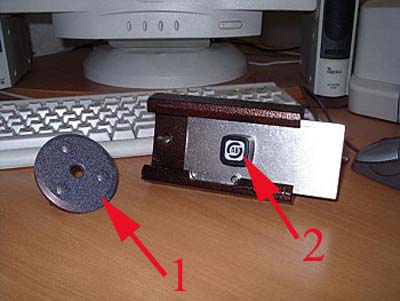
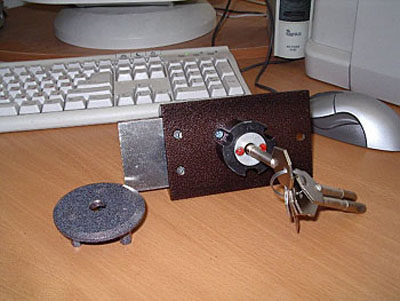
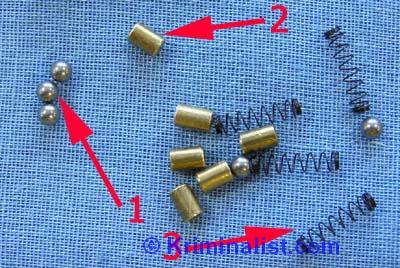
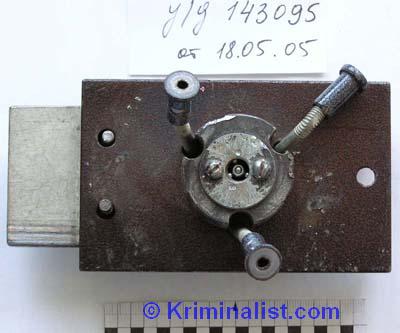
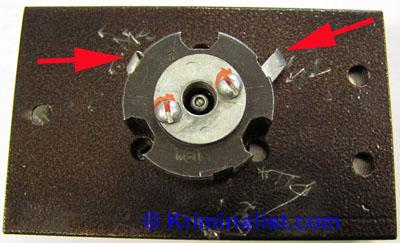
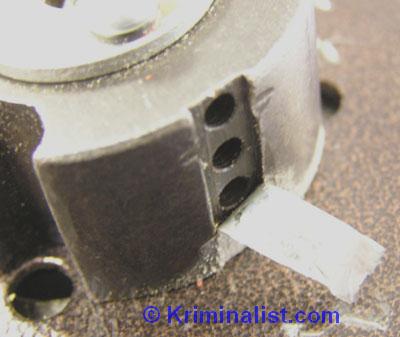
Within the framework of this article, I would like to conduct a comparative test of two overhead locks with a cylinder locking mechanism. These are the Barrier-2 and Barrier-2M locks, manufactured by OOO Polivektor, St. Petersburg. Castle Barrier-2 Photo 1. View of the castle Barrier-2. Red arrows with numbers: 1 - a metal plate is marked, which serves as a protection for the cylinder mechanism and is an element for fastening the lock; 2 - the handle is marked, with the help of which the crossbar is moved. Lock Barrier-2M Photo 2. View of the castle Barrier-2M. Red arrows with numbers: 1 - a metal plate is marked, which serves as a protection for the cylinder mechanism and is an element for fastening the lock; 2 - the handle is marked, when turned, the deadbolt moves. Castle Barrier Photo 3. View of the castle from the outside. Photos 1, 2 and 3 are taken from the manufacturer's site (LLC 'Polivektor'). As you can see in photos 1 and 2 (see marks 2), the locks differ only in the handles that move the crossbar. In the Barrier-2 lock, to open it, you need to unlock the bolt by lifting the handle up and then move the bolt. This procedure could be carried out from the outside of the door by drilling a hole through which the handle was lifted and then the bolt was moved to the side. In the Barrier-2M lock, the handle design has been changed, it has become rotary. Thus, the manufacturer has eliminated the possibility of criminal unlocking the lock in the above way. Another difference is the way the cover plate is attached. Both models have the same cylinder mechanism. The secrecy of the lock is provided by 3 rows of pins, 3 pins in a row. The design of the code mechanism is as follows: a steel ball, they are all of the same diameter, serves to transfer information from the key to the code pin; Code pin; Support pin; Spring. Photo 4. View of the pins of the cylinder mechanism of the Barrier locks. Red arrows with numbers indicate: 1 - code pins (steel balls); 2 - support and code brass pins, differ only in size; 3 - springs. Cutting of key secrets has 4 standard sizes, secrecy is provided by 9 pins. The step of cutting the secret is 0.5 mm. The total error is 0.3 mm. Thus, the secrecy is 49 = 262144 secrets. After making a series of locks using the entire number of secrets, the angle of the pins is changed and a new series is made. The design of the lock is simple, the quality of the manufacture of parts of the lock, assembly and painting is satisfactory. The lock comes with installation instructions, according to which a hole is made in the door leaf for the cylinder mechanism. Next, the lock is fastened with three screws to the door leaf and with a protective plate installed outside the door and fastened to the lock with three screws. With this installation, by removing the protective plate, there is access to the cylinder, which can be acted upon by various methods of burglary. The plate can be removed in the following ways: knock down (in the Barrier-2 locks); Drill out the attachment points (in the Barrier-2 and Barrier-2M locks); Unscrew and unscrew the fastening screws with a flat key (in Barrier-2M locks). These methods were not just invented by me, but by thieves, burglars. Here are typical real life examples (the most common hacking methods). Castle Barrier-2 Photo 5. View of the Barrier-2 castle, which was knocked out into the apartment by blows on the cylinder mechanism. The fastening points of the lock could not withstand the applied force. Castle Barrier-2 Photo 6. View of the Barrier-2M castle, opened in the following way. The protective plate on the outside of the door was squeezed out a few millimeters, which made it possible to slip a flat key under it and unscrew the fastening nuts of the protective plate. After that, the thief bent back the metal plates covering the holes with pins (marked with red arrows) and removed the springs, support pins and code pins. After that, the lock can be opened with any key. I think it's time for the manufacturer to change the design of the cylinder for door locks, especially since there is no need to invent anything. At the Barrier in the S-300 and S-600 models (safe versions), a protective hood is put on the cylinder, which excludes the above-described method of breaking the lock. Photo 7. Enlarged image of a cylinder mechanism with a bent plate covering the hole with pins. Most of the thefts are committed due to improper installation of locks on the door. But these are claims not to the manufacturer of locks, but to the door doors. No one has installed wooden entrance doors for a long time. I consider the correct installation of a lock in a metal door when only a 9 mm diameter hole for a key is visible from the outside of the door. All fasteners of the lock must be made inside the door leaf. Thus, the outer metal sheet of the door itself will additionally protect the lock. When installing Barrier locks in accordance with the manufacturer's instructions, several methods of breaking are possible, which will be discussed below. The first method is the most difficult and time-consuming one - drilling the key guide in order to remove the security elements of the lock (pins).















 Blog
Blog
 Tools
Tools map
map